The reason I bored you with the Yoneda equipment was to eventually double back to Tannakian reconstruction.
In a nutshell, Tannakian reconstruction lets us reconstruct the hom-set from a set of natural transformations between fiber functors:

Here, the end goes over the presheaf category.
We have previously learned that we can define a presheaf object in a double category, together with the evaluation functor 

In an equipment, we can define it as a companion to the Yoneda functor:

Furthermore, in a Yoneda equipment, as a generalization of full-faithfullness, we postulate that the unit of the adjunction:

is an isomorhpism:

The only missing piece of the puzzle is to realize that the end in the Tannakian formula is the right Kan lift.
Right Kan Lift
The right Kan Lift is defined as the right adjoint to postcomposition. This definition is easy to interpret when only functors are involved, because postcomposition is well defined: Postcomposing with 

so the right lift is defined as:

The order of composition of profunctors is more convention-dependent, and the convention I used was for diagram-order composition, which happens to be the opposite of functor composition.
Thus, in 

In components, the left hand side is a double end:

Expanding the profunctor composition, we get:

Using co-continuity, we can pull the coend out:

We then curry the product:

and re-arrange the ends:

We conclude that the right Kan lift is given by the formula:

What we did is a pretty standard calculation of a mapping out of a profunctor composition. We pull out the coend to turn it into an end, and then we curry the product.
A right Kan lift can be defined in a double category (actually, all we need is the horizontal=bicategorical part of it) using the counit 2-cell:
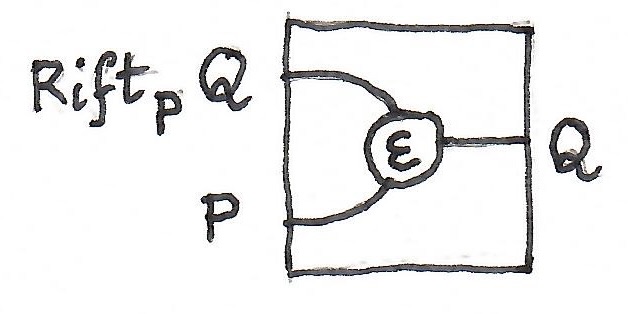
satisfying the universal property: Any 2-cell of the same shape as the counit uniquely factorizes through the counit:
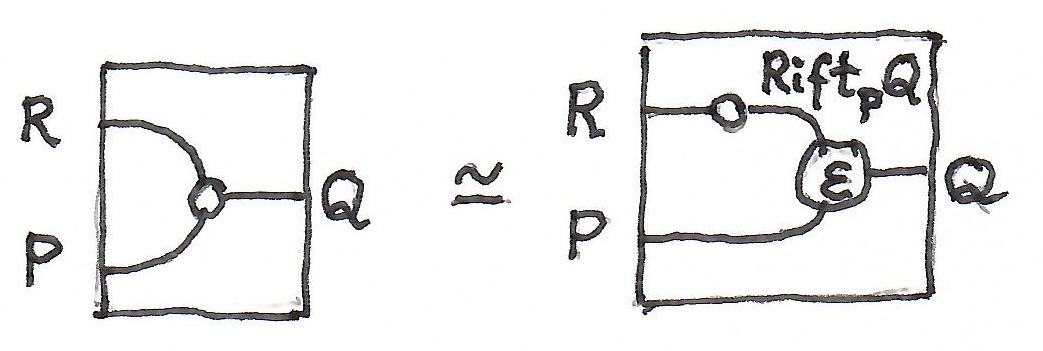
Tannakian Reconstruction
We can now see that, in

In a Yoneda equipment, the evaluation profunctor is the companion to the Yoneda functor, so we can replace 

Using the definition of the Right Kan lift as a right adjoint to postcomposition we have, for any 

In a proarrow equipment, the companion 

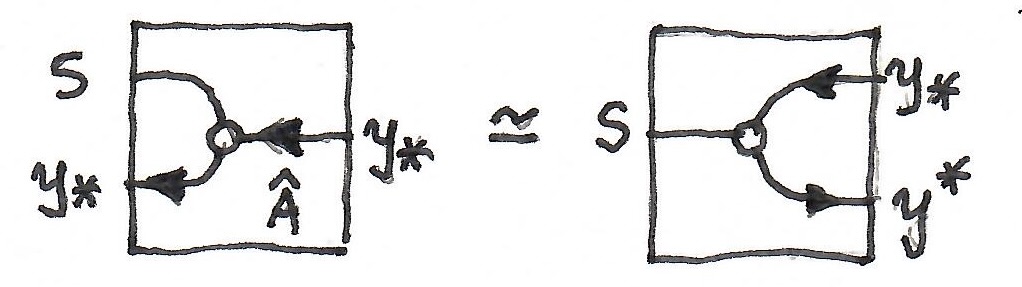
We get:

Since

Finally, in a Yoneda equipment we postulate the analog of the full-faithfullness of the Yoneda embedding:
The Tannakian reconstruction in a Yoneda equipment can therefore be written as:

In a profunctor equipment, the unit on the right hand side is the hom-profunctor 
Leave a Reply